
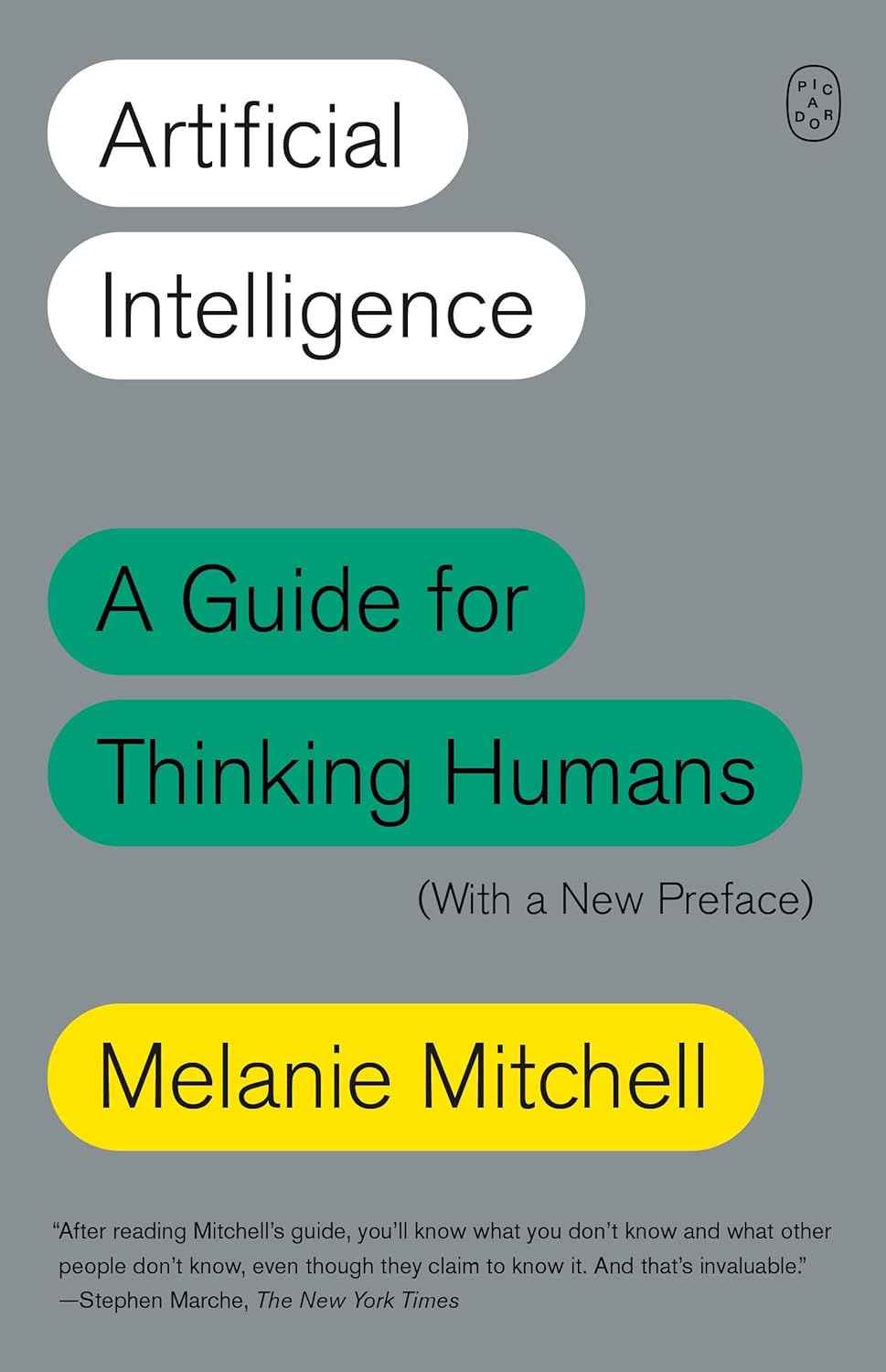
Artificial Intelligence: A Guide for Thinking Humans
Melanie Mitchell (2019) | Farrar, Straus and Giroux

PART 1: SECTION-BY-SECTION LOGICAL MAPPING
PROLOGUE: Terrified
Core Claim: Douglas Hofstadter’s terror at the 2014 Google AI meeting was not fear of malevolent superintelligence but fear of the opposite—that human creativity and consciousness might be products of shallow, easily replicated mechanisms.
Supporting Evidence:
Deep Blue defeated Kasparov in 1997 despite playing in a “very unhuman way” through brute-force lookahead
David Cope’s EMI program composed Chopin-style mazurkas that fooled professional musicians at the Eastman School of Music
Google AI researchers at the meeting expressed personal puzzlement at Hofstadter’s terror; to them, AI progress was simply the goal, not a cause for dread
Logical Method: Contextual framing via anecdote + contrast between insider and outsider reactions to AI progress.
Logical Gaps:
Mitchell presents Hofstadter’s terror sympathetically but does not yet assess whether his fear is logically warranted—this is deferred to the book’s conclusion
The “bystander Turing test” framing of chess and music is implicit, not argued: the reader is expected to accept these as tests of human uniqueness without that premise being examined
Methodological Soundness: Strong as framing device; no empirical claims are made that require validation here.
CHAPTER 1: The Roots of Artificial Intelligence
Core Claim: AI was founded on a conjecture—that every feature of intelligence can be precisely described so a machine can simulate it—and that conjecture remains unverified 70 years later.
Supporting Evidence:
The 1956 Dartmouth proposal’s stated research areas (NLP, neural networks, machine learning, abstract concepts) are identical to AI’s active research agenda in 2019
Early predictions (Simon’s 1957 “chess champion in 10 years,” Minsky’s “substantially solved in a generation”) all proved false
Rosenblatt’s perceptron learning algorithm demonstrated measurable success on simple pattern recognition but failed to scale
Minsky and Papert’s 1969 Perceptrons proved the mathematical limits of single-layer perceptrons and dampened investment in subsymbolic approaches for a decade
Logical Method: Historical narrative + technological genealogy + identification of recurring failure modes.
Logical Gaps:
The “easy things are hard” paradox is introduced but not yet mechanistically explained—why are face recognition and language understanding harder than chess? The answer is deferred to later chapters
The claim that funding cuts triggered AI winters conflates correlation with causation; the cuts may have reflected genuine technical limits rather than caused them
Methodological Soundness: Strong historical reconstruction; appropriately avoids overclaiming about what the history proves for the future.
CHAPTER 2: Neural Networks and the Ascent of Machine Learning
Core Claim: Multi-layer neural networks trained by backpropagation can learn to perform tasks for which no explicit rules can be written, but what they actually learn differs fundamentally from human learning.
Supporting Evidence:
The perceptron trained on 60,000 handwritten digit examples achieved ~80% accuracy; a two-layer network with 50 hidden units achieved ~94%—a 14-point improvement from hidden layers alone
Minsky and Papert’s speculation that multi-layer networks would be “sterile” was explicitly falsified by the development of backpropagation
Rumelhart and McClelland’s Parallel Distributed Processing (1986) argued that expert systems’ brittleness reflected their inability to capture subconscious knowledge
DARPA’s 1988 claim that neural networks were “more important than the atom bomb” illustrates the hype-winter cycle
Logical Method: Ablation logic (removing hidden layers degrades performance) + historical narrative of symbolic vs. subsymbolic competition.
Logical Gaps:
The 80% vs. 94% comparison is on a single task; generalization of the architectural advantage is not demonstrated here but assumed
The “alchemy” characterization of hyperparameter tuning (cited from Corvitz) is introduced early but not yet developed into an argument about reliability
Methodological Soundness: Sound. The digit recognition comparison is a controlled demonstration, not merely an anecdote.
CHAPTER 3: AI Spring
Core Claim: The current AI spring is driven by deep learning’s combination with big data and GPU hardware, producing narrow AI systems of genuine power—but the field systematically conflates narrow achievement with general progress.
Supporting Evidence:
AlexNet achieved 85% top-5 accuracy on ImageNet (2012), a ~13-point jump over the previous year’s best non-neural-network approach
Google’s self-teaching cat-detector in 2012 identified cats from YouTube videos without being told what a cat was
AlphaGo defeated Lee Sedol 4-1 in March 2016, watched by 200+ million people
Kevin Kelly’s “take X and add AI” formulation captures the commercial dynamic accurately
Logical Method: Documented milestone enumeration + market context.
Logical Gaps:
Mitchell notes that “as soon as it works, no one calls it AI anymore” (McCarthy) but does not yet examine whether this definitional slippage is intellectually legitimate or a form of moving the goalposts
Kurzweil’s singularity predictions are presented alongside skeptical responses without Mitchell yet adjudicating between them
Methodological Soundness: Adequate as orientation. No individual claims here require deep empirical defense.
CHAPTER 4 (Chapter 3 in audiobook numbering): Looking and Seeing
Core Claim: Convolutional neural networks, inspired by Hubel and Wiesel’s visual cortex hierarchy, have achieved genuine advances in object recognition—but these advances are narrower and more fragile than the “surpassing humans” headlines claim.
Supporting Evidence:
ImageNet Top-5 accuracy improved from 72% (2010) to 98% (2017 final competition)
AlexNet’s architecture—trained on 1.2M images, 60M weights, one week on a GPU cluster—achieved results that shocked the computer vision community
Human baseline of ~5% error rate was derived from a single annotator (Andrej Karpathy) testing on 1,500 images after training on 500—not a representative human population sample
ConvNets trained on web photos performed poorly on robot-captured household images, demonstrating domain-specific overfitting
Logical Method: Competitive benchmark analysis + lesion studies of architectural components + adversarial example demonstrations.
Logical Gaps:
The “human parity” claim rests on Top-5 accuracy; no reported comparison exists for Top-1 accuracy, where machine performance (~82%) is substantially lower
ConvNet activation maps are technically described as learning hierarchical features, but Mitchell appropriately notes that what the network actually learned remains opaque
The blurry-background confound (Will Landecker’s experiment) proves that a specific network learned the wrong features, but does not prove that this failure is universal
Methodological Soundness: Rigorous. The distinction between “statistically better on this benchmark” and “human-level object recognition” is maintained throughout.
CHAPTER 5 (Bias, Explainability, and Adversarial Examples)
Core Claim: The opacity of deep networks is not merely a philosophical problem—it produces biased outputs, unpredictable failures, and catastrophic vulnerability to adversarial manipulation.
Supporting Evidence:
Google Photos tagged Black users as gorillas in 2015; the fix was to remove “gorilla” from the label vocabulary, not to fix the model
A widely used face recognition training dataset was 77.5% male and 83.5% white (Crawford, cited)
Szegedy et al. showed that imperceptible pixel changes could cause AlexNet to classify a school bus as an ostrich with high confidence
The University of Wyoming group evolved images indistinguishable from noise that ConvNets classified as specific objects with >99% confidence
Adversarial stickers on stop signs caused autonomous-vehicle vision systems to classify them as speed limit signs
Logical Method: Documented failure case enumeration + adversarial example methodology (whitebox attacks).
Logical Gaps:
The Baidu cheating incident is instructive but occupies disproportionate space relative to its logical contribution to the chapter’s main argument
Mitchell notes that humans also make perceptual errors (Müller-Lyer illusion) but appropriately distinguishes human error types from ConvNet vulnerability types—though this contrast could be developed more rigorously
The defense problem (no general solution exists) is correctly stated but receives less analysis than the attack problem
Methodological Soundness: Strong. The chapter benefits from a dense base of peer-reviewed adversarial example research, not just anecdote.
CHAPTER 6 (Chapter 7 in audiobook): Trustworthy and Ethical AI
Core Claim: The “Great AI Trade-Off” between capability and reliability is not merely technical—it is political, because deploying unreliable AI systems at scale harms real people, disproportionately those with less power.
Supporting Evidence:
ACLU testing of Amazon Rekognition incorrectly matched 28 of 535 Congress members with criminal database photos; 21% of errors involved Black representatives (who constitute 9% of Congress)
The Pew 2018 survey found 63% of technology practitioners expected AI to leave humans better off by 2030; 37% disagreed—genuine expert uncertainty, not consensus
The EU’s GDPR “right to explanation” requirement generates interpretive ambiguity about what constitutes “meaningful information about the logic involved”
The trolley problem survey found 76% approved of utilitarian self-driving cars sacrificing passengers to save pedestrians, but a majority said they would not personally buy such a car
Logical Method: Survey evidence + documented deployment failures + regulatory analysis + philosophical case studies.
Logical Gaps:
The trolley problem receives substantial attention despite Mitchell’s acknowledgment that it is “a highly contrived scenario that no real world driver will ever encounter”—this undermines its value as an analytical tool
The argument that AI ethics requires multi-stakeholder governance is correct but underdeveloped; who exactly should be in the room is not specified
Asimov’s laws are used to illustrate the limits of rule-based ethics, but the comparison to actual AI system design is implicit rather than explicit
Methodological Soundness: The empirical examples are well-sourced. The normative arguments are appropriately framed as Mitchell’s own positions rather than settled conclusions.
CHAPTERS 7-8 (Reinforcement Learning and Game Playing)
Core Claim: Deep reinforcement learning produced genuinely superhuman performance in Go and Atari games, but these achievements do not demonstrate general intelligence because (a) no transfer learning occurs between tasks and (b) the systems learn contingencies, not concepts.
Supporting Evidence:
DeepMind’s DQN scored >10x human average on Breakout by discovering the “tunneling” strategy without being told the game’s objective
AlphaGo Zero, trained with zero human knowledge beyond rules, defeated AlphaGo Lee 100-0 in 100 games
Uber AI Labs found that a random search over network weights matched or exceeded DQN performance on 5 of 13 Atari games—suggesting the domain is less challenging for AI than assumed
Shifting the paddle’s screen position by a few pixels caused a trained Breakout player’s performance to “plummet,” suggesting the system had not learned the concept of “paddle”
Changing screen background color caused significant performance degradation in a trained Pong player
Logical Method: Performance benchmarking + ablation studies + transfer failure demonstrations.
Logical Gaps:
The “tunneling strategy” is described as a discovery, but Mitchell appropriately raises the question of whether the system has the concept of tunneling. The answer—it doesn’t—is well-supported but relies on the transfer failure evidence, which is cited but not systematically reviewed
Hassabis’s claim that AlphaGo’s training involved “no human guidance” is correctly challenged (network architecture, MCTS, hyperparameters are human-designed), but the scope of this challenge could be stated more precisely
The random search finding (Uber) is presented as undermining DQN’s significance, but Mitchell does not address the counter-argument that the same randomness result would not hold for Go
Methodological Soundness: The transfer failure experiments are the methodological core; they are real studies with clear results. The conceptual argument (contingency vs. concept) is logically sound but relies on behavioral inference.
CHAPTERS 9-10 (Natural Language Processing)
Core Claim: Deep learning has produced genuine advances in speech recognition, sentiment analysis, and machine translation, but all current NLP systems process language without understanding it—and this lack of understanding produces characteristic failure modes.
Supporting Evidence:
Speech recognition error rates dropped dramatically post-2012; Mitchell’s phone correctly transcribed the restaurant story at normal speaking speed
“Moose is my favorite dessert” was transcribed as “moose [the animal] is my favorite dessert”—the system lacked the contextual knowledge to disambiguate
Google Translate’s French rendering of “what about the bill?” produced “what about the proposed legislation?”—wrong word sense selected due to context blindness
Microsoft and Alibaba programs exceeded the Stanford-measured “human accuracy” of 87% on SQuAD—but the human baseline was measured differently from the machine’s task, and the test requires only answer extraction, not reasoning
Winograd schema challenge: best AI system achieved ~61% accuracy; random guessing yields 50%; humans are near 100%
Logical Method: Benchmark performance comparison + specific failure case analysis + controlled linguistic test design (Winograd schemas).
Logical Gaps:
The SQuAD human baseline critique is correct and important, but Mitchell could push further: the 87% “human” figure itself was derived from Mechanical Turk workers answering questions with the answer guaranteed to exist in the paragraph—not representative human reading comprehension
The restaurant story translation examples are vivid and probative but constitute an n=1 test; Mitchell acknowledges the systems are “continually being improved” without specifying whether the structural problem (context blindness) could be fixed with more data
Methodological Soundness: The Winograd schema analysis is the strongest methodological section—it is a test explicitly designed to require understanding, not pattern matching, and the 61% machine result vs. ~100% human result is a clean gap.
CHAPTERS 11-13 (Understanding, Knowledge, Abstraction, and Analogy)
Core Claim: Human intelligence rests on core intuitive knowledge (physics, biology, psychology), mental simulation, and analogy-making. No current AI system possesses these capacities. Programs like Copycat and Situate demonstrate the approach but “only scratch the surface.”
Supporting Evidence:
Barsalou’s simulation hypothesis: understanding concepts involves subconsciously running mental models built from sensorimotor experience
Lakoff and Johnson’s Metaphors We Live By: abstract concepts (time, sadness, love) are structured through metaphors grounded in physical experience
The physical warmth/social warmth experiment: subjects who held hot coffee rated a fictional person as significantly “warmer” than those who held iced coffee
Copycat solved many letter-string analogy families but could not solve problems requiring new concept formation on the fly (e.g., Problem 4 and 5 in the text)
ConvNets trained on 20,000 “same/different shape” examples performed only slightly above chance; humans scored near 100%
Logical Method: Psychological evidence review + computational demonstration (Copycat) + explicit capability gap analysis.
Logical Gaps:
The Barsalou simulation hypothesis and Lakoff-Johnson metaphor thesis are described as established findings, but both remain contested in cognitive science. Mitchell does not flag this uncertainty
Copycat is presented as a demonstration of the right approach without evidence that the approach would scale. The argument is: (1) humans use abstraction and analogy; (2) Copycat implements a computational version of these; (3) therefore this approach is promising. Step (3) does not follow from (1) and (2) without evidence of scaling
The hot-coffee experiment is cited to support embodied cognition, but this line of research has faced replication challenges that Mitchell does not mention
Methodological Soundness: The Copycat section is methodologically honest (Mitchell explicitly lists problems it could not solve). The psychological evidence is presented as more settled than the scientific literature supports.
EPILOGUE: Questions, Answers, and Speculations
Core Claim: General human-level AI is not on the near-term horizon; the real near-term risks are AI’s brittleness, bias, and misuse, not superintelligence.
Supporting Evidence:
Kurzweil-Kapoor long bet: Mitchell predicts Kapoor wins (no program will pass their strict 2-hour Turing test by 2029)
The tail-risk framing (Mullainathan): machines make many good decisions, then fail spectacularly on edge cases not in training data
Dominguez: “People worry computers will get too smart and take over the world. But the real problem is that they’re too stupid and they’ve already taken over the world.”
Embodiment hypothesis: human intelligence may require a body interacting with the world, not just computation
Logical Method: Argument from current technical limitations + expert survey data + logical extension of prior chapters.
Logical Gaps:
The embodiment hypothesis is invoked as “increasingly compelling” to Mitchell without being argued from first principles. It is a hypothesis, not a demonstrated constraint
The prediction that the Kurzweil-Kapoor bet will go to Kapoor is stated with confidence but rests on Mitchell’s assessment of current progress, which could be wrong
The book ends on a note of openness (”nearly all the important questions are still unsolved”) which, while intellectually honest, somewhat undercuts the argumentative arc of the preceding chapters
Methodological Soundness: The tail-risk argument is the book’s strongest normative conclusion and is well-grounded in the preceding technical analysis.
BRIDGE: Synthesizing the Logical Architecture
The book’s central argument, stated plainly: Current AI systems are powerful narrow tools that do not understand what they process. Every major claim of “human-level” AI performance rests on benchmark-specific conditions that dissolve under stress. The gap between narrow competence and general intelligence is not a matter of scale—more data and deeper networks—but of kind: understanding requires core knowledge, mental simulation, abstraction, and analogy that no current architecture provides.
Three structural tensions animate the book:
Tension 1: Progress vs. Understanding. Mitchell must simultaneously argue that recent AI advances are genuine and significant (they are) and that they do not constitute progress toward general intelligence (they don’t, or not obviously). This requires constant disambiguation between “better performance on task X” and “closer to human intelligence.” Mitchell performs this disambiguation carefully but the reader must remain attentive—the two claims are often conflated in the popular sources she cites and critiques.
Tension 2: Behavioral vs. Mechanistic standards. The Turing test was a behavioral standard: if it acts intelligent, it is intelligent. Deep learning researchers largely operate on behavioral standards (benchmark performance). Mitchell argues for a mechanistic standard: a system is intelligent only if it achieves performance via something like the right processes (understanding, not pattern-matching). But this standard is hard to operationalize, and Mitchell’s preferred tests (Winograd schemas, Bongard problems) are themselves behavioral—they just probe for understanding-requiring behaviors. The book never fully resolves this.
Tension 3: Honesty about limits vs. continued investment. Mitchell is honest throughout about the limits of her own research program (Copycat “only scratched the surface”) while arguing that the approach is nonetheless the right one. This intellectual honesty is admirable but leaves the reader without a strong positive vision for what the path forward looks like.
The book’s most proven claims:
Deep learning systems are brittle and fail in characteristic, non-human ways
Current NLP systems process language without semantic understanding
Transfer learning across tasks is essentially absent from current AI systems
“Human-level” benchmark claims routinely rest on flawed or narrow baselines
The book’s most significant unproven claims:
The embodiment hypothesis as a necessary condition for general intelligence
The Lakoff-Johnson metaphor framework as an account of how human concepts actually work (contested in cognitive science)
That Copycat-style analogy-making represents a scalable path toward general intelligence
The book’s most significant acknowledged gaps:
No existing theory explains how intuitive core knowledge is encoded in the brain
No one knows the minimal computational requirements for human-level language understanding
Whether general AI will arrive in decades or centuries is genuinely unknown
PART 2: LITERARY REVIEW ESSAY
The Comfortable Pessimist
There is a particular rhetorical advantage available to the AI skeptic that Melanie Mitchell exploits throughout Artificial Intelligence: A Guide for Thinking Humans, and exploits well: the capacity to be right about everything that matters and wrong about nothing specific. Every claim she makes is defensible. Every limitation she identifies in current AI is real. Every warning she issues about hype, brittleness, bias, and adversarial vulnerability is well-grounded in peer-reviewed research. The book is, in this sense, intellectually impeccable. It is also, in a way worth examining carefully, structurally evasive at the precise moment it most needs to commit.
Mitchell’s central argument is this: we overestimate AI and underestimate our own intelligence. Deep learning systems—convolutional neural networks, recurrent networks, reinforcement learning agents—achieve genuine and sometimes startling narrow competence, but they do not understand what they process. They are brittle in characteristic ways: adversarial examples fool them via pixel perturbations invisible to humans; they fail to transfer what they learn across related tasks; their errors are categorically different from human errors. The gap between current AI and general human-level intelligence is not a matter of scale but of kind. Something crucial is missing. That something is understanding, grounded in core intuitive knowledge, mental simulation, abstraction, and analogy.
This argument is correct. The question worth examining is whether “correct” is enough.
Mitchell opens with a scene that any writer would envy: Douglas Hofstadter, standing before a room of Google AI engineers in 2014, declaring himself terrified. Not of robots. Not of Terminator scenarios. Terrified that human creativity and consciousness might turn out to be disappointingly shallow—that a program manipulating musical syntax rules could produce Chopin-like mazurkas that fooled professional musicians, and that this fact might mean Chopin himself was never doing anything more profound. The engineers were baffled. They had spent their careers trying to make AI better. Why would success be frightening?
Mitchell spends the rest of the book trying to answer that question while simultaneously adjudicating it. Her method is not polemical but pedagogical: take the reader through how these systems actually work, examine the benchmarks on which they are evaluated, show the gaps between benchmark performance and genuine capability, and let the evidence speak. This is the right method for this audience and this moment. The book succeeds at it.
But Hofstadter’s terror points toward a question Mitchell never quite confronts directly: what would it mean to be right? If Hofstadter is right that what we most value in human creativity is more than pattern manipulation, what is the positive account? And if we got there—if we built a machine with genuine understanding, genuine analogy-making, genuine common sense—would Hofstadter be reassured or more terrified? Mitchell doesn’t say. She ends the book with the observation that intelligence may require embodiment, that the question of what general AI would require remains open, and that nearly all the important problems are unsolved. These statements are true. They are not conclusions.
The book’s most rigorous section—the chapters on natural language processing—is where Mitchell’s methodology is at its sharpest. She identifies a specific pattern: a benchmark is designed, human performance is measured under conditions that favor humans, machine performance is measured under conditions that favor machines, the numbers converge, and headlines declare “human parity.” The SQuAD reading comprehension dataset is her clearest example. The test guarantees that every answer exists as a phrase in the provided paragraph—a constraint that eliminates precisely the kind of reading comprehension that makes reading comprehension hard. Machines that “surpassed human accuracy” on SQuAD were doing answer extraction, not reading. Mitchell names this clearly.
The Winograd schema analysis extends the argument. Consider: The trophy doesn’t fit in the suitcase because it’s too big. What is too big? Humans answer instantly. The best AI systems scored 61% accuracy—barely above random guessing at 50%. The gap is not a matter of more training data. The gap is that answering correctly requires knowing that trophies and suitcases are physical objects with sizes, that fitting inside means the contained object must be smaller than the container, and that common sense licenses the inference from “doesn’t fit” to “too big” rather than “too small.” None of this is in any training corpus. It is in the world.
I find this the most persuasive strand of Mitchell’s argument, and I find it persuasive not because of what it proves about current systems but because of what it proves about the problem structure. The failure on Winograd schemas is not a failure of scale. You cannot get to 100% accuracy on these problems by training on more text. You get there by understanding physical objects, spatial relationships, and causal inference. That is not a benchmark problem. That is the actual problem.
The chapter on adversarial examples deserves more analytical weight than it receives. Mitchell presents the finding—imperceptible pixel changes cause confident misclassification—as evidence of brittleness and lack of understanding, which it is. But the adversarial example literature points to something more structurally significant that the book only gestures toward. If a network trained on millions of school buses classifies a school bus as an ostrich because of a specific pixel-level perturbation, the network has not learned school bus as a concept. It has learned a function that maps certain pixel distributions to the label “school bus” and is sensitive to the label boundary in ways no human would be. The function and the concept are not the same thing. This is not just a practical limitation—it is evidence that the learning task as currently formulated does not require learning what we want it to learn. More data will not fix this. A different formulation is required.
Mitchell comes close to this conclusion but pulls back. She asks “are we fooling ourselves when we think these networks have actually learned the concepts we are trying to teach them?” and answers yes. But she does not draw the architectural implication: that supervised learning on static labeled datasets is, in principle, the wrong substrate for concept learning. Saying it plainly would strengthen the book’s argument considerably.
The chapters on abstraction and analogy—where Mitchell presents her own research on the Copycat program—are the most intellectually honest section of a largely honest book. Mitchell names precisely what Copycat cannot do. It cannot form new concepts on the fly. It cannot recognize that Problem 4 in the Bongard set requires a concept the system has never encountered. The program solves many analogy families in a “human-like way” but “only scratches the surface.” This is the right level of epistemic modesty.
What is missing is the other half of the argument: why should we believe that more Copycat-like architecture, rather than more deep-learning-like architecture, is the right direction? The analogical approach is motivated by a theory of human cognition—Hofstadter’s active symbols, Barsalou’s simulation hypothesis, Lakoff and Johnson’s metaphorical grounding. But Mitchell presents these theories as more settled than they are. Barsalou’s work is influential but contested. The embodied cognition program has not produced the consensus Mitchell implies. The warm-coffee/social-warmth experiment she cites as supporting evidence for embodied metaphor has faced replication challenges she does not mention.
This is the book’s most significant methodological gap. The positive research program Mitchell advocates—analogy-based, embodied, simulation-grounded—is motivated by cognitive science findings that are less secure than the deep-learning failure cases she documents. The asymmetry matters: the critique rests on firm empirical ground; the alternative rests on contested theoretical ground.
Where does this leave the reader? With a book that is genuinely excellent at its stated task: giving thinking humans an accurate, technically grounded, intellectually honest account of what AI can and cannot do, why the hype systematically exceeds the reality, and what the genuine risks of deployed AI systems are in the near term. The tail-risk argument—machines make many good decisions, then fail spectacularly on edge cases their training data did not cover—is both correct and actionable. The critique of “human parity” benchmark claims is necessary and well-executed. The documentation of bias in face recognition systems is important.
But the book’s title promises a guide for thinking humans, and thinking humans will eventually ask: given all this, what should be done? Mitchell’s answer is that general AI is far away and that current concerns should focus on reliability, bias, and misuse. This is almost certainly correct as a near-term prioritization. It is less satisfying as a conclusion.
Hofstadter was terrified that AI might show us human creativity was a bag of tricks. Mitchell’s book argues—correctly—that current AI hasn’t shown that yet and likely can’t. What it cannot quite bring itself to say is whether that’s because the bag-of-tricks hypothesis is wrong, or simply because the bag of tricks isn’t big enough yet. That question remains, as Mitchell herself acknowledges, open. In an era of confident proclamations in both directions, the intellectual honesty to leave it open is itself a contribution. But it is not quite the same as an answer.
Tags: Melanie Mitchell artificial intelligence critique, deep learning limitations explained, Winograd schema natural language understanding, Hofstadter Gödel Escher Bach AI, embodied cognition machine intelligence gap